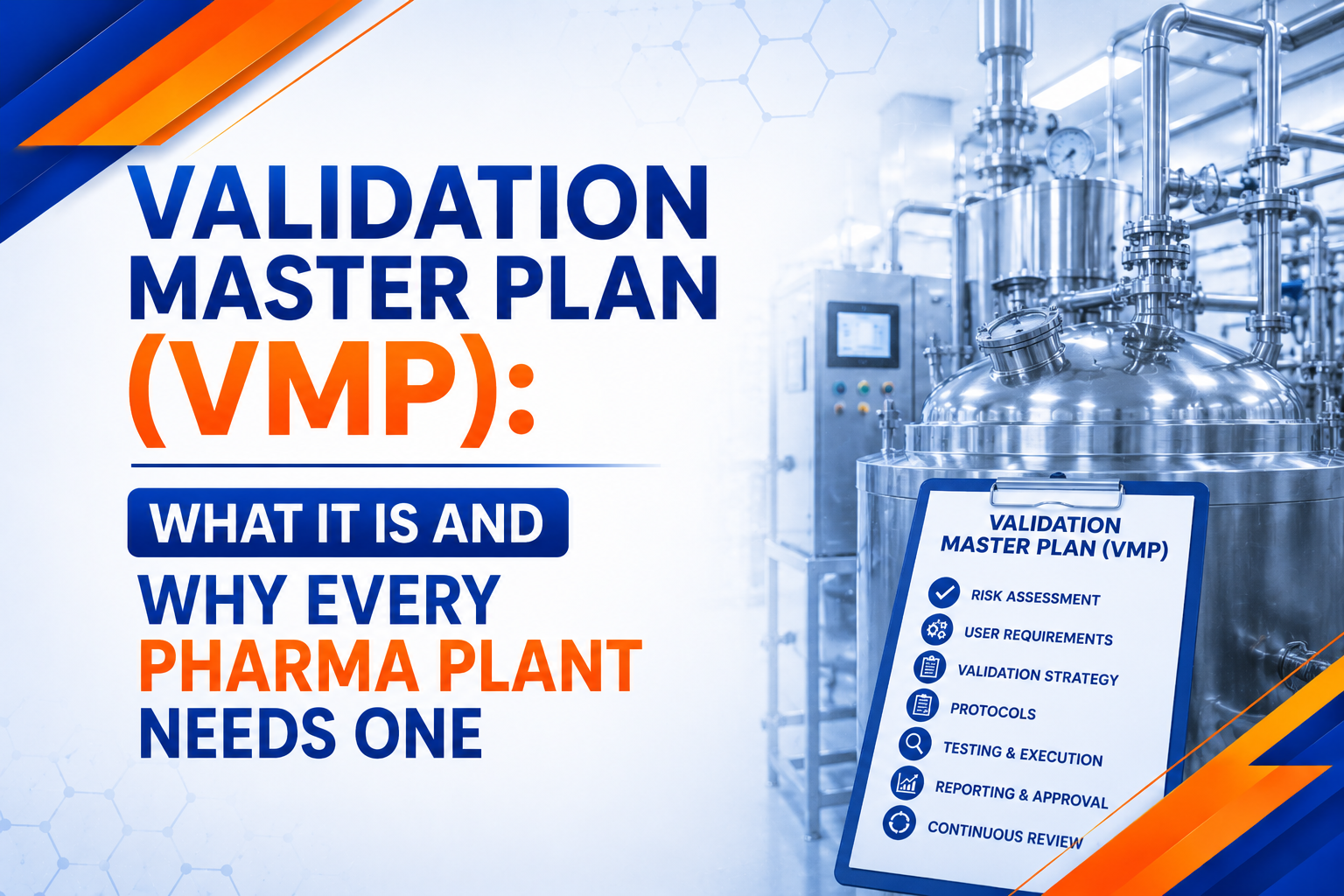
A Validation Master Plan (VMP) is the single document that tells regulators, auditors, and your own team exactly how validation is organized across a pharmaceutical site. Without it, even a well-run plant can look disorganized during an inspection. With it, every qualification and every piece of validation documentation in pharma points back to one clear strategy.
JD Pharma Consultants is a trusted pharmaceutical consulting firm that has helped manufacturing sites build, update, and defend their VMPs in front of FDA, WHO-GMP, and EU regulators. In this guide, we explain what a Validation Master Plan in pharmaceutical industry operations actually covers, why it matters, and how to build one that holds up under scrutiny.
What Is a Validation Master Plan (VMP)?
A Validation Master Plan (VMP) is a formal document that outlines the overall philosophy, intention, and approach a pharmaceutical company uses for validation. It is not a protocol itself. Instead, it is the roadmap that connects every individual validation activity, from equipment qualification to cleaning validation, into one coherent system.
Think of the VMP as the table of contents for your entire validation program. It lists what needs to be validated, who is responsible, what methods will be used, and what timeline the site is following. Regulatory bodies such as the FDA and the European Medicines Agency expect every manufacturing site to have one, and it is specifically referenced in EU GMP Annex 15 as the planning document defining what, how, and why validation is performed.
A well-written pharmaceutical validation master plan typically includes the following sections.
- Validation policy and overall philosophy
- Organizational structure and responsibilities
- List of facilities, systems, equipment, and processes to be validated
- Format and content standards for protocols and reports
- Acceptance criteria and risk-assessment approach
- Change control and revalidation triggers
- A schedule or matrix showing planned validation activities
Why Validation in Pharmaceutical Manufacturing Matters
Validation in pharmaceutical manufacturing exists to prove, with documented evidence, that a process, system, or piece of equipment consistently does what it is supposed to do. This is not paperwork for its own sake. It is the foundation of product safety, patient trust, and batch-to-batch consistency.
The FDA’s guidance on process validation describes a three-stage lifecycle: process design, process qualification, and continued process verification. Commercial process design is based on knowledge gained through development and scale-up activities, the design is then evaluated to determine if it can support reproducible commercial manufacturing, and ongoing assurance continues during routine production.
Without proper validation, a plant risks inconsistent product quality, contamination, and equipment failure. With a documented validation program tied to a clear master plan, the same plant can demonstrate control over every critical step, from raw material handling to final packaging.
Why Every Pharma Plant Needs a Validation Master Plan
Some smaller manufacturers assume a VMP is only necessary for large multinational sites. In reality, every facility that manufactures, packages, or tests pharmaceutical products benefits from one, regardless of size.
Here is why a Validation Master Plan (VMP) is non-negotiable for any serious pharma operation.
- Regulatory expectation. Health authorities including the FDA, WHO, and EU regulators expect a VMP as part of routine GMP inspections.
- Single source of truth. It prevents departments from running validation activities in isolation, which often leads to duplicate work or missed steps.
- Audit readiness. Inspectors frequently ask for the VMP first, since it shows the inspector how the rest of the validation documentation in pharma is organized.
- Risk-based prioritization. A good VMP uses risk assessment to decide which systems need the most rigorous testing, saving time and resources.
- Change control discipline. It defines exactly when revalidation is triggered, such as after equipment changes, process modifications, or facility upgrades.
- New product and tech transfer support. It gives a ready-made framework for validating new products, equipment, or transferred processes.
GMP Validation Requirements and the Regulatory Backbone of a VMP
GMP validation requirements are written into the regulations and guidance documents that authorities use during inspections. Two references stand out as the backbone of most VMPs worldwide.
The FDA’s guidance, Process Validation: General Principles and Practices, lays out the three-stage lifecycle approach used across the United States and increasingly referenced worldwide. Annex 15 of the EU GMP guidelines directly addresses qualification and validation, including the VMP itself, and interprets the principles of good manufacturing practice for medicinal products set out in EU directives for human-use medicinal products.
The World Health Organization also maintains its own validation guidelines under its Technical Report Series, which many manufacturers in emerging markets rely on for GMP certification and export approval. Aligning your pharma plant validation strategy with these three frameworks, FDA, EU Annex 15, and WHO, gives a site the broadest possible regulatory coverage.
Key Components of Pharmaceutical Validation Services
When JD Pharma Consultants is engaged to build or revise a VMP, our pharmaceutical validation services typically cover several interconnected areas, each feeding into the master plan as a distinct workstream.
- Design Qualification (DQ): Confirms that the proposed design of a facility, system, or equipment is suitable for its intended use.
- Installation Qualification (IQ): Verifies that equipment and systems are installed correctly according to specifications.
- Operational Qualification (OQ): Confirms that equipment operates as intended across its full operating range.
- Performance Qualification (PQ): Demonstrates that the process or equipment performs consistently under real production conditions.
- Process validation: Confirms that a manufacturing process consistently produces a product meeting predetermined quality attributes.
- Cleaning validation: Proves that cleaning procedures remove residues to an acceptable, scientifically justified level.
- Computer system validation (CSV): Confirms that software and automated systems used in manufacturing and quality functions perform reliably and maintain data integrity.
Each of these activities generates protocols, raw data, and reports. The VMP ties them together so an auditor, or a new employee, can see the complete picture without digging through dozens of disconnected files.
Validation Documentation in Pharma: Getting the Paper Trail Right
Validation documentation in pharma is often where audits succeed or fail. A site can have excellent equipment and a skilled team, yet still receive observations because the paperwork does not match the activity performed.
Good documentation practice means every protocol is approved before execution, every deviation is recorded and investigated, and every report is reviewed and signed before a system is released for use. The FDA’s guidance is direct on this point, stating that documentation at each stage of the process validation lifecycle is essential.
A strong VMP sets the documentation standards up front, including templates, numbering systems, retention periods, and review responsibilities. This consistency makes it far easier to maintain validation documentation in pharma across multiple product lines or even multiple sites under the same company.
How JD Pharma Consultants Builds a VMP That Works in the Real World
We do not believe in generic templates copied from one client to the next. As a trusted pharmaceutical consulting firm, our approach to building a pharmaceutical validation master plan starts with understanding your specific facility, product portfolio, and regulatory targets.
Our process generally includes the following steps.
- A gap assessment of your current validation status against FDA, EU Annex 15, and WHO expectations
- Risk-based mapping of all systems, equipment, and processes that require validation
- Drafting the VMP structure, policy statements, and validation matrix
- Aligning protocol templates and report formats with the new master plan
- Training your internal team to execute and maintain the VMP going forward
- Ongoing support during inspections, audits, and revalidation cycles
This is hands-on work built on direct experience supporting pharmaceutical manufacturers through real regulatory inspections, not theoretical advice from a textbook.
Common Mistakes Pharma Plants Make With Their VMP
Many of the gaps we find during client assessments repeat across the industry. Recognizing them early saves time and rework.
- Treating the VMP as a one-time document instead of a living plan that gets reviewed annually
- Failing to link the VMP to actual change control records
- Writing a VMP that is too generic to reflect the site’s real equipment and processes
- Leaving out clear ownership, so no single person is accountable for keeping it current
- Not updating the VMP after a major equipment change, expansion, or new product launch
Avoiding these mistakes is often the difference between a smooth inspection and a list of observations that take months to close out.
FAQs About Validation Master Plans
1. What is the difference between a Validation Master Plan and a validation protocol? A Validation Master Plan is the overall strategy document for the entire site. A validation protocol describes how one specific piece of equipment, process, or system will be tested. The VMP sits above all protocols and explains how they fit together.
2. How often should a Validation Master Plan be updated? Most regulatory guidance recommends reviewing the VMP at least once a year, or immediately after a major change such as new equipment, a facility expansion, or a new product line. Treating it as a static document is a common reason inspectors raise observations.
3. Is a Validation Master Plan mandatory for small or mid-sized pharma plants? Yes. GMP validation requirements apply regardless of company size. Smaller plants without a formal VMP often struggle more during inspections because their validation activities appear scattered and unplanned.
4. Who is responsible for maintaining the VMP within a pharma company? Quality Assurance typically owns the VMP, with input from production, engineering, and validation teams. Senior management approval is usually required since the VMP commits company resources to the validation program.
5. Can a pharmaceutical consulting firm help if we already have an outdated VMP? Yes. A firm experienced in pharmaceutical validation services can perform a gap assessment, identify what is missing or outdated, and rebuild the VMP around your current regulations and operations, rather than starting from a blank page.
Ready to Strengthen Your Validation Program?
A Validation Master Plan is not just a regulatory checkbox. It is the backbone of consistent product quality and audit confidence for your entire facility. If your current VMP is outdated, incomplete, or missing entirely, JD Pharma Consultants can help you build one that works on your production floor and stands up to regulatory scrutiny.
Contact JD Pharma Consultants today for VMP gap assessment and take the