Pharmaceutical Quality Control and Assurance
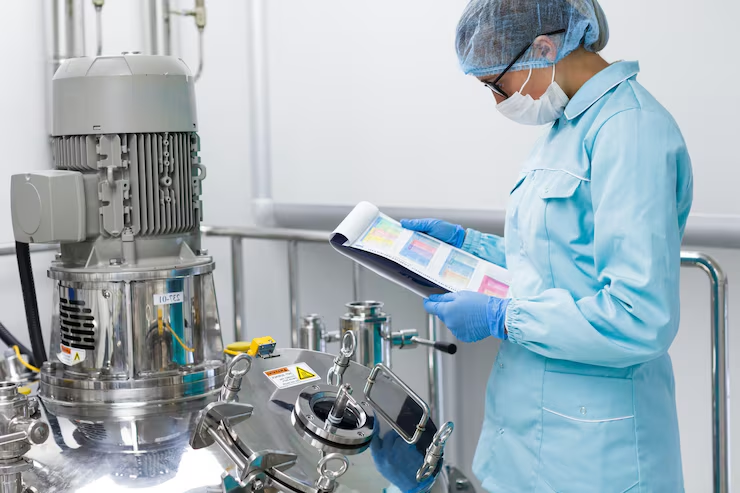
Pharmaceutical Quality Control and Assurance Services
Is your pharma manufacturing unit producing medicines that consistently meet quality, safety, and regulatory standards?
JD Pharma Consultant provides structured Pharmaceutical Quality Control and Assurance services that help manufacturers build reliable systems, pass regulatory audits, and deliver medicines patients can trust. Whether you are setting up a new facility or strengthening an existing one, our QA QC expertise ensures your plant runs right from day one.
What Are Pharmaceutical Quality Control and Assurance Services?
Pharmaceutical quality control refers to the testing and verification processes that confirm a product meets its defined specifications before release. Quality assurance in the pharma industry refers to the broader system of planned activities that ensure every stage of manufacturing consistently produces a compliant product.
Together, QA and QC form the backbone of GMP compliance in any pharma plant. According to the WHO, more than 10% of medicines in low and middle-income countries are substandard or falsified, highlighting the global need for stronger pharmaceutical quality management systems. In India, the revised Schedule M regulations have raised the bar for all domestic manufacturers.
JD Pharma Consultant helps pharma manufacturers across India implement both systems in a practical, audit-ready manner.
Who Is This Service For?
- New pharma plant owners requiring QMS setup from scratch
- Existing manufacturers preparing for WHO-GMP, USFDA, or EU GMP audits
- Contract manufacturing organisations (CMOs) looking to improve quality scores
- Pharma exporters targeting regulated markets in Africa, Europe, or North America
- Companies implementing turnkey pharma project services that need QA QC integrated from plant design
What Are the Real Benefits of a Strong Pharma QA QC System?
Regulatory Audit Readiness at All Times
A well-implemented pharmaceutical quality management system keeps your plant ready for surprise inspections by CDSCO, state drug authorities, or international regulators. Clients who work with us consistently report faster audit clearances and fewer observations.
Reduction in Batch Failures and Rejections
Poor quality control in the pharmaceutical industry leads to batch rejections, product recalls, and financial loss. Our QC systems reduce in-process deviations through standardised testing protocols and trained personnel.
GMP Compliance Built Into Daily Operations
GMP quality control in pharma is not a one-time activity. We help you embed quality into your SOPs, workflows, and equipment protocols so compliance becomes routine rather than reactive.
Faster Product Approvals and Market Entry
A certified pharmaceutical quality assurance system speeds up drug master file submissions, product registrations, and export certifications. This directly shortens your time to market.
Protection of Brand and Patient Safety
For pharma manufacturers in India, quality failures are public and permanent. Our services protect your brand reputation by ensuring every product that leaves your facility meets the required standard.
Integrated Automation and Traceability
We implement automation technologies including ERP and Manufacturing Execution Systems (MES) that reduce human error, capture real-time data, and create complete traceability from raw material to finished product.
How Does JD Pharma Consultant Implement QA QC Systems?
Step 1: Current State Assessment
Does your existing system have gaps that could trigger regulatory non-compliance? We begin with a detailed gap analysis of your current quality systems against applicable GMP standards such as WHO, Schedule M, or USFDA. This gives a clear picture of where action is needed.
Step 2: Quality Management System Design
We design a Quality Management System tailored to your product types, manufacturing scale, and target regulatory markets. This includes SOP frameworks, document control systems, change control processes, deviation management, and CAPA (corrective and preventive action) workflows.
Step 3: Analytical Laboratory Setup
Can your in-house lab support GMP testing requirements? We set up analytical laboratories for raw material testing, in-process quality testing, and finished product analysis. This includes instrument qualification, method validation, and laboratory information management systems (LIMS).
Step 4: Automation and IT System Integration
We implement automation technologies to streamline manufacturing operations, reduce human error, and ensure end-to-end traceability. This includes Enterprise Resource Planning (ERP) systems for production and inventory control and Manufacturing Execution Systems (MES) for real-time shop floor monitoring. These tools connect quality data across your entire pharma plant.
Step 5: Training, Audit Support, and Handover
Systems are only as strong as the people using them. We train your QA QC team on all implemented systems, conduct internal pre-audit simulations, and support you through your first regulatory inspection. A full handover document pack is provided at project close.
What Is Included in Our Pharma QA QC Service Package?
- Regulatory gap analysis against WHO-GMP, Schedule M, USFDA, or EU GMP
- Full QMS design including SOPs, policies, and quality manual
- Document management system setup and training
- Analytical laboratory design and instrument qualification
- Raw material, in-process, and finished product testing protocol development
- Method validation and analytical transfer support
- ERP and MES system selection, configuration, and implementation
- Deviation management, CAPA, and change control system setup
- Batch manufacturing record (BMR) and batch packaging record (BPR) templates
- Environmental monitoring and cleanroom qualification protocols
- Personnel training programme for QA QC team
- Pre-audit mock inspection and audit response support
Pharmaceutical Plant Construction Services: Built for Quality from the Ground Up
Does your pharma plant construction plan account for GMP layout requirements before the first brick is laid?
JD Pharma Consultant integrates quality assurance requirements directly into the pharmaceutical plant construction phase. This means your facility is designed and built to support cleanroom standards, cross-contamination prevention, material and personnel flow separation, and environmental controls from the very start.
Our pharma plant construction services cover civil design coordination, GMP-compliant layout validation, utility system planning (HVAC, water purification, compressed air), and construction supervision to ensure that every structural element supports regulatory compliance.
Clients across Madhya Pradesh, Gujarat, Uttarakhand, and Himachal Pradesh have benefited from our integrated approach, where QA planning and plant construction happen in parallel rather than in sequence.
Pharmaceutical Plant Installation Services: Equipment That Performs and Qualifies
Is your equipment installed in a way that will pass IQ, OQ, and PQ qualification protocols?
Our pharmaceutical plant installation services ensure that every piece of manufacturing and laboratory equipment is installed, qualified, and integrated correctly. We manage Installation Qualification (IQ), Operational Qualification (OQ), and Performance Qualification (PQ) for all critical equipment including tablet compression, coating, granulation, filling, and lyophilisation systems.
We work with equipment suppliers across India and internationally to coordinate delivery schedules, site readiness, vendor supervision, and final commissioning. Our team also ensures that equipment installation data is captured in a format accepted by regulatory inspectors.
For manufacturers in pharma clusters such as Baddi, Haridwar, Hyderabad, and Ahmedabad, we offer on-site installation supervision and post-installation qualification support.
Why Do Pharma Manufacturers Choose JD Pharma Consultant for QA QC?
- Hands-on experience with WHO-GMP, revised Schedule M, USFDA, and EU GMP implementation
- Track record across 100+ pharma projects including formulation, injectable, API, and herbal units
- Local knowledge of pharma regulatory requirements in Madhya Pradesh, Rajasthan, Gujarat, and Himachal Pradesh
- Integrated approach connecting QA QC systems with plant construction and installation phases
- Practical, documentation-ready output that works in real regulatory inspections
- Dedicated QA QC project manager for every client engagement
- Post-implementation audit support with a 90-day response commitment
Reactive QC vs. Integrated QA QC System: What Is the Real Difference?
Parameter | Reactive QC Only | Integrated QA QC System |
Batch Failure Rate | High due to late detection | Reduced through in-process controls |
Audit Readiness | Gaps discovered during audit | Continuous compliance monitoring |
Regulatory Observations | Frequent, sometimes critical | Minimal with pre-audit simulation |
Documentation | Inconsistent, often incomplete | Standardised, audit-trail ready |
Cost of Quality | High due to rework and recalls | Lower through deviation prevention |
Export Eligibility | Limited to unregulated markets | Qualified for WHO, USFDA, EU markets |
Which Pharma Sectors Do Our QA QC Services Cover?
- Oral solid dosage manufacturing (tablets, capsules, granules)
- Liquid orals and topical formulations (syrups, suspensions, ointments)
- Sterile and injectable product manufacturing plants
- Active Pharmaceutical Ingredient (API) facilities
- Herbal, ayurvedic, and nutraceutical manufacturers
- Biotechnology and biosimilar production units
- Contract manufacturing organisations (CMOs) serving domestic and export markets
- Hospital and institutional medicine supply units
QA QC Readiness Checklist for Pharma Manufacturers
Use this checklist to assess where your facility stands before a regulatory inspection.
- Quality Management System (QMS) documented and implemented
- SOPs in place for all critical manufacturing and testing operations
- Analytical laboratory equipped and instruments qualified
- Raw material, in-process, and finished product testing protocols validated
- ERP or MES system operational with traceability enabled
- Deviation management and CAPA system active
- BMR and BPR templates reviewed and approved by QA head
- Environmental monitoring programme running with trend data available
- Personnel training records current for all QA QC staff
- Pre-audit internal inspection completed within last 6 months
Frequently Asked Questions about Pharmaceutical Quality Control and Assurance
What is the difference between quality control and quality assurance in pharma?
Quality control in the pharmaceutical industry refers to the testing activities that verify a product meets its specifications. Quality assurance is the broader system of processes and documentation that ensures quality is consistently built into manufacturing. QA is proactive; QC is confirmatory. Both are required under GMP regulations.
Is a pharmaceutical quality management system mandatory in India?
Yes. Under the revised Schedule M notified by the Ministry of Health and Family Welfare, all licensed pharmaceutical manufacturers in India are required to implement a documented Quality Management System. Non-compliance can result in licence suspension, product recalls, or export bans.
How long does it take to implement a QMS for a pharma plant?
A basic QMS implementation for a small to mid-size pharma unit typically takes 3 to 6 months. Full implementation including laboratory setup, ERP integration, and pre-audit simulation can take 6 to 12 months depending on plant complexity and regulatory scope.
What is GMP quality control in pharma?
GMP quality control means that all testing, sampling, and release activities in a pharma plant are performed according to Good Manufacturing Practice guidelines. This includes validated test methods, qualified instruments, trained analysts, and documented results that can be reviewed by regulatory inspectors.
What is a pharmaceutical quality management system?
A pharmaceutical quality management system is a structured set of policies, procedures, and processes that govern how a pharma company manages product quality from raw material procurement through manufacturing, testing, and distribution. It includes elements like document control, change management, deviation handling, CAPA, and internal audit programmes.
Can JD Pharma Consultant help prepare for a WHO-GMP audit?
Yes. We provide complete WHO-GMP audit preparation including gap analysis, documentation review, system rectification, personnel training, and mock inspection. Our clients in Madhya Pradesh, Gujarat, and Himachal Pradesh have successfully cleared WHO pre-qualification audits with our support.
What is the role of ERP and MES in pharma quality systems?
ERP (Enterprise Resource Planning) systems manage production planning, inventory, and procurement with quality checkpoints integrated at every stage. MES (Manufacturing Execution Systems) provide real-time control and data capture at the shop floor level. Together they reduce manual errors and create a complete, traceable quality record across the manufacturing process.
Do you support pharma QA QC in small and medium scale units?
Yes. JD Pharma Consultant works with pharma units of all sizes. For smaller manufacturers, we design scalable QA QC systems that are affordable, practical, and fully compliant with state drug authority requirements. Many of our clients in Madhya Pradesh and Rajasthan started as small units and have since expanded with our continued support.
What is included in analytical laboratory setup for a pharma plant?
Analytical laboratory setup includes laboratory layout design, equipment selection and qualification (HPLC, UV spectrophotometer, dissolution tester, Karl Fischer titrator, and others), method development and validation, LIMS implementation, and analyst training. We ensure the lab meets the GMP requirements for pharma QC testing services.
How does quality assurance affect pharma export eligibility?
Regulated export markets such as the USA, European Union, and WHO pre-qualified markets require documented evidence of a functioning QA system before granting product approvals. Without a certified pharmaceutical quality assurance framework, Indian manufacturers cannot access these high-value markets. Our QA implementation directly improves export readiness.